
B) Child Protection
B1) Overview
ELC meets its child protection responsibilities by:
- making all staff and homestay providers aware of their responsibilities. having an ELC safeguarding team whose members and roles are known to all staff and homestay providers
- making sure that a member of the safeguarding team can always be contacted 24/7.
- training all staff and homestay providers and making them aware of different child protection scenarios and training them to recognise symptoms of abuse
- making sure all staff and homestay providers know how to respond when they suspect abuse or when a child tells them about abuse.
ensuring the safeguarding team are themselves fully trained.
B2) ELC’s Safeguarding team – roles and responsibilities
*Full contact details are given in Child Protection C2
Designated Safeguarding Lead (DSL)
Neil Mullens (Director of Operations)
Mob: 07842 431726
Trained to Safeguarding Level 3
Deputy Designated Safeguarding Lead (DDSL)
Andrew Edwards (Principal)
Office: Ground Floor - office 102,
1 The Avenue
Mobile: 07521062436
Trained to safeguarding level 3
Deputy Designated Safeguarding Lead (DDSL)
Beatrice Convert (Admissions Manager)
Office - Ground Floor Reception 101
1 The Avenue
Phone: 01179707060
Trained to safeguarding level 3
Rob Farrow – Clifton College - Director of Safeguarding
Tel: 0117 3157567, 07562 616027
Nicola Laird - Local Authority Designated Officer – LADO (Acting)
For child protection concerns re under 18s with an adult in a position of trust, ie our staff and homestay providers
Tel: 0117 9037795, 07795 091020 LADO@bristol.gov.uk Out of hours number 01454 615165 or call number given on answerphone message.
First Response
For child protection concerns with external parties and other students 0117 9036444 (08.30 – 17.00 Monday to Thursday and 08.30 – 16.30 on Friday.
Out of hours number 01454 615165 or call number given on answerphone message.
Keeping Bristol Safe Partnership
For advice with policy and procedures. Contact: www.bristolsafeguardingineducation.org - (safeguardingineducationteam@bristol.gov.uk, 0117 9222710)
ELC has a safeguarding team made up of a DSL (Designated Safeguarding Lead) and DDSLs (Deputy Designated Safeguarding Leads). During the normal school day, there is always a member of the safeguarding team available.
A member of the safeguarding team can be contacted 24 hours a day, 7 days a week by calling the school emergency number: 07747 021261, or the mobile numbers listed above.
Members of the ELC safeguarding team contact the Local Authority Designated Officer (LADO) if there are child protection concerns involving adults in positions of trust, such as ELC staff or homestay providers.
If the child protection concern involves someone not directly connected with the school, or another student, the safeguarding team contacts First Response.
ELC also receives support from the Director of Safeguarding at Clifton College. This person helps with ELC’s yearly safeguarding audit and provides advice and updates to the safeguarding team.
For advice and support with safeguarding policies and procedures, ELC can also contact the team leader of Bristol’s Safeguarding in Education Team.
B3) When Adults need to respond – Saying nothing is not an option
ELC has a duty of care to all students. All adults working at ELC should understand their responsibility to protect students under 18 and anyone who may be at risk of harm.
If you have a safeguarding concern, you must report it immediately to a member of the safeguarding team.
A member of the safeguarding team will take the appropriate action. If the concern:
- involves an adult who works with children, the safeguarding team will inform the LADO within 24 hours of receiving the report;
- meets the Local Authority threshold for safeguarding concerns, the safeguarding team will refer the matter to the appropriate local authority service, such as First Response in Bristol.
The safety and welfare of the child must always be the main priority when deciding whether information should be shared. This is more important than keeping information confidential.
If a child needs medical attention, this must be treated as an urgent priority.
If a child is in immediate danger, call 999.
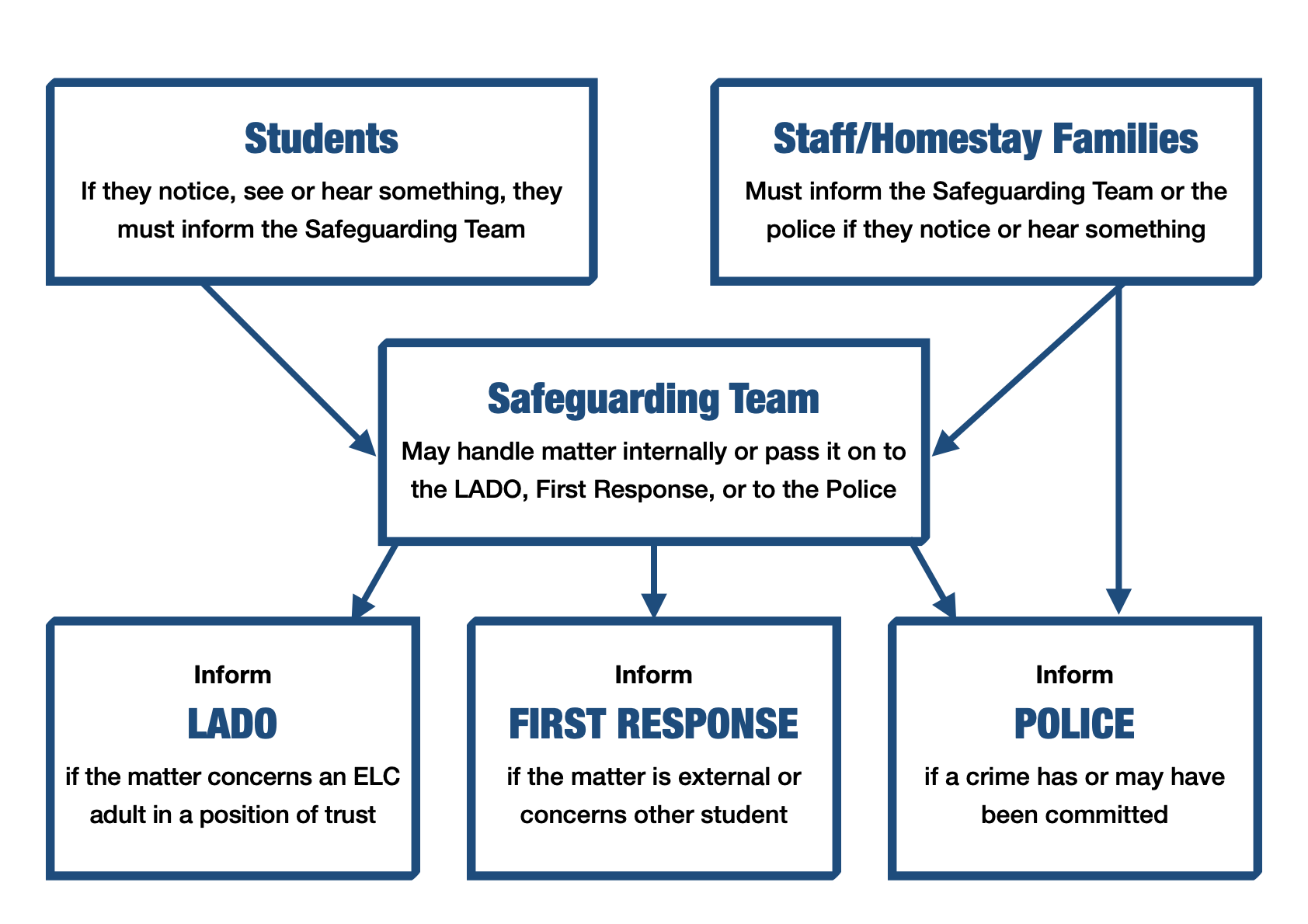
See flow chart in C7 for more detailed information
* If you have a concern about a member of staff, you must report this directly to the Clifton College Headmaster (0117 3157190).
B4) Recognising symptoms of abuse
All staff working with children should understand the different types of abuse. These are explained below. If any adult has concerns about signs or behaviour in a child, they must report them to the DSL immediately.
PHYSICAL ABUSE:
- Physical signs: Injuries not adequately explained including: fractures, bruises, burns, bite marks, slap marks and implement marks (e.g. belt mark) grip marks, symmetrical bruising or bruising in unusual places
- Behavioural signs: Appears scared of others, avoids communication with authority. Mood swings, can be both passive and aggressive, frozen watchfulness, equally could appear overly “happy” and “eager to please”. Anti-social and even criminal behaviour.
SEXUAL ABUSE:
- Physical Signs: Over-familiarity, explicit sexual drawings, pain, soreness or itching in the genital or anal areas or mouth, recurrent genital or urinary infections, pregnancy.
- Behavioural Signs: Sleep problems, anorexia, bulimia, self-harm or excessive ‘comfort’ eating, fear of a specific person, alcohol or use of drugs, unexplained gifts, money, having ‘secrets’ particularly around internet use or overtly sexual display.
NEGLECT:
- Physical Signs: Looks excessively thin or ill, unexplained weight loss, complains of hunger; lack of energy, untreated conditions/injuries, repeated accidents, especially burns, repeatedly unwashed, smelly or dressed inappropriately for the weather.
- Behavioural Signs: Poor level of concentration, constantly hungry, not keeping Doctor or Hospital appointments, frequently not at school or persistent lateness.
EMOTIONAL ABUSE:
- Physical Signs: Speech disorders, depression, eating disorders, evidence of self-harm and voicing suicidal thoughts.
- Behavioural Signs: Over-reaction to mistakes, continual self-deprecation, excessive fear of new situations, excessive behaviours, e.g. rocking, head banging, pulling own hair out, self-harm and/or eating disorders, stealing, excessively sad, depressed, withdrawn, low self-esteem, unable to form friendships with other students.
B5) Disclosure (if a child tells an adult) - what you should do
When abuse is disclosed, observed or suspected, staff should:
- stay calm. Listen with care, reassurance, seriousness and sincerity and keep an open mind;
- do not take a decision as to whether or not the abuse has taken place;
- do not communicate shock, anger or embarrassment;
- do not interrupt when the child is recalling significant events;
- reassure the child;
- do not ask leading or closed questions. Instead, ask open questions e.g. “How did this make you feel?”;
- take care not to make assumptions about what the student is saying and do not make suggestions to the student as to an alternative explanation for their concerns;
- do not promise confidentiality to a student who makes a disclosure but make clear to the student that you will need to pass on their concerns to help keep them safe;
- check that you have correctly understood what the student is trying to tell you. Listen and remember;
- write an accurate record of the conversation using the students' own words. The record should include; the date and time; the place of the conversation; the essence of what was said and done by whom and in whose presence. Do not add opinions or interpretations. The written record of the disclosure should be signed and dated;
- all suspicions or complaints of abuse must be reported to the DSL, or a DDSL, as soon as possible.
REMEMBER:
If a child discloses abuse to you, take it seriously. Seek advice from the DSL
B6) Keeping Records
Accurate record keeping is essential in safeguarding. These records help to identify patterns of behaviour and provide adequate and appropriate responses to under 18s who may be at risk of harm.
If someone discloses to you, you must:
- Make notes using the under 18’s own words
- Record the date, time, place, words used by the child and how the child appeared to you
- Write your notes up in detail as soon as possible on an ELC Concern (and Disclosure/Allegation) form and give/send this to the safeguarding team
- Give any hand written notes (taken at the time of allegation made) to the safeguarding team.
- Record statements and observable things – do not add opinions
- Do not assume anything – don’t speculate or jump to conclusions.
Completed Concern (and Disclosure/Allegation) forms must be given to a member of ELC’s safeguarding team. The only members of staff with access to these documents are members of ELC’s Safeguarding Team. Confidentiality must be maintained throughout the process.
Electronic Records
ELC uses SharePoint where it keeps its Welfare and Safeguarding records. On the system, there is an area for
- Staff training (both initial and refresher)
- All Safeguarding contact details are kept on SharePoint
Annual Safeguarding Audit
Every year, ELC conducts an audit which is not a report on any individual cases but an overview of what has happened in Safeguarding during the previous 12 months. The report notes.
- Number of concerns raised and dealt with (statistics)
- If any patterns have emerged
- How effective safeguarding strategies have been
- If any major safeguarding issues have arisen
- Record of training done and any changes made to training procedures
- Any changes in Safeguarding staff
- Any feedback from staff / students regarding Safeguarding awareness
- Any areas of weakness noted.
- If any new initiatives should be considered /implemented over the coming year.
Clifton College's Safeguarding Director (Rob Farrow) audits the report and checks it against available evidence and in discussion with the ELC’s Safeguarding Team. Once it has been passed as accurate, a strategy meeting is held with the Safeguarding Team to discuss the report and the way to make improvements.
B7) If an adult is accused

Terminology for possible outcomes to investigation that meet the harms threshold.
The LADO will be informed within 24 hours of the allegation being reported.
| Definition | Meaning |
|---|---|
| Substantiated | There is sufficient identifiable evidence to prove the allegation. |
| False | There is sufficient evidence to disprove the allegation. |
| Malicious | There is clear evidence to prove there was a deliberate act to deceive and the allegation is false. |
| Unfounded | There is no evidence which supports the allegation. It could be that the person making the allegation misinterpreted the incident or did not know all the circumstances. |
| Unsubstantiated | There is insufficient evidence to prove or disprove the allegation (it is not the same as 'false'). |
| Resolution of allegation | Action by school |
|---|---|
| Allegation substantiated, leading to prosecution and dismissal | Inform DBS; record kept on file |
| Allegation substantiated, leading to disciplinary action or dismissal | May need to inform DBS; record kept on file |
| Allegation unsubstantiated | Summary report kept in staff file for future clarification and reduce need for reinvestigation; copy given to accused |
| Allegation unfounded or malicious | Report removed from file. Disciplinary action required against perpetrators of malicious story. |
ELC Bristol has a duty of care to its employees and will provide adequate support for anyone facing an allegation. The school must maintain confidentiality regarding the member of staff the allegation relates to. Until any investigation, either internal or external, has been completed, the identity of the accused must not be released. If the allegation is unsubstantiated, unfounded or malicious, ELC Bristol will support the member of staff on their return to work, especially if they have been suspended.
B8) If a child or another student over 18 is accused
It may happen that the person being alleged to have a child is also a child. In such circumstances the school has a duty of care to both the children involved. In such a case, ELC will also appoint a second member of the Safeguarding Team to support the alleged perpetrator. The procedure is then the same as with any case of suspected abuse by an adult. As always, it is essential that appropriate confidentiality is maintained.
If the person alleged of abusing a child is an ELC student over 18, the procedure is the same as when dealing with an allegation of abuse made against any adult. However, the school again has a duty of care to both parties. In all cases, the school’s absolute priority must be to ensure that the alleged victim is kept safe. The DSL/CPO or the ADSL/Vice Principal will contact First Response immediately on 0117 903 6444.
First Response may suggest additional measures to further protect the victim and the alleged perpetrator may be excluded from the school or asked to change class or homestay in order to avoid further contact with the alleged victim.
B9) Child Sexual Exploitation - official definition used as statutory guidance in England
Sexual exploitation of children and young people under 18 involves exploitative situations, contexts and relationships where young people (or a third person or persons) receive 'something' (e.g. food, accommodation, drugs, alcohol, cigarettes, affection, gifts, money) as a result of them performing, and/or another or others performing on them, sexual activities. Child sexual exploitation can occur through the use of technology without the child's immediate recognition; for example being persuaded to post sexual images on the Internet/mobile phones without immediate payment or gain. In all cases, those exploiting the child/young person have power over them by virtue of their age, gender, intellect, physical strength and/or economic or other resources. Violence, coercion and intimidation are common, involvement in exploitative relationships being characterised in the main by the child or young person's limited availability of choice resulting from their social/economic and/or emotional vulnerability.
Some of the following signs may be indicators of sexual exploitation:
- Appearing with unexplained gifts or new possessions
- Going missing for periods of time or regularly coming home late
- Misuse of drugs or alcohol
- Having older boyfriends or girlfriends
ELC staff and accommodation providers must be aware about Child sexual exploitation and recognise it is a form of abuse and if this is disclosed to them by an Under 18 or if they believe that this may be happening, they must immediately inform a member of the ELC Safeguarding team.
B10) Female Genital Mutilation (FGM)
Staff should be aware that FGM is the non-medical partial or total removal of external female genital organs, typically done to young girls from African countries. FGM is illegal if done in the UK and illegal if a UK resident is taken to another country to have it done. If a member of staff or an accommodation provider becomes aware that this has happened or suspects it may happen to a student under 18, it is their duty to notify both the Safeguarding team and the Police.
Edited by Neil Mullens 29 May 2026